Contemporary Ethical Issues by Walter G. Jeffko
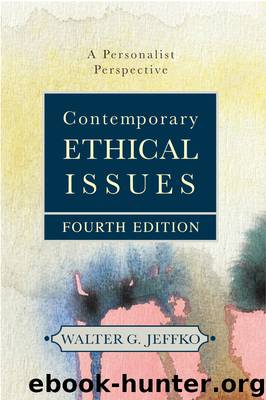
Author:Walter G. Jeffko
Language: eng
Format: epub
ISBN: 9781633884427
Publisher: Prometheus Books
Plants, which merely have life, are all alike for animals, and all animals are for man. Wherefore it is not unlawful if man uses plants for the good of animals, and animals for the good of man….
Now the most necessary use would seem to consist in the fact that animals use plants, and men use animals, for food, and this cannot be done unless these be deprived of life: wherefore it is lawful both to take life from plants for the use of animals, and from animals for the use of men.10
Since animals exist for the sake of humans, the morality of our treatment of animals is determined solely by its effect on humans. Thus, for example, “he that kills another's ox, sins, not through killing the ox, but through injuring another man in his property. Wherefore this is not a species of the sin of murder but of the sin of theft or robbery.”11
Unlike Descartes, who thought of animals as machines, Aquinas, following Aristotle, sees animals as sentient organisms, capable of feeling pleasure and pain. At the same time, since the lower is for the sake of the higher, and since humans constitute the highest level of creation, animals have solely instrumental value. Their value is determined by the human ends or purposes for which God has created them. They lack any value in themselves, any intrinsic value. Still, animals may not be used for any human end whatsoever, but only for those that are grounded in rational and biological human nature.
Kant's position is similar to Aquinas's, except that, from a moral standpoint, he has only two levels of creation: humans and nonhumans. Humans are persons, and they constitute the higher level of creation. As we saw in chapter 3, for Kant, a person is a rational and self-conscious subject, capable of autonomy. As such, a person is an end-in-itself, having unconditioned (or intrinsic) value. Nonhumans include the rest of creation: animals, plants, and inanimate things. They are solely means to human ends and thus have merely instrumental value. Consequently, we have indirect duties to animals only insofar as they promote our direct duties to persons. As Kant writes:
Download
This site does not store any files on its server. We only index and link to content provided by other sites. Please contact the content providers to delete copyright contents if any and email us, we'll remove relevant links or contents immediately.
| Anthropology | Archaeology |
| Philosophy | Politics & Government |
| Social Sciences | Sociology |
| Women's Studies |
The remains of the day by Kazuo Ishiguro(8999)
Tools of Titans by Timothy Ferriss(8394)
Giovanni's Room by James Baldwin(7346)
The Black Swan by Nassim Nicholas Taleb(7129)
Inner Engineering: A Yogi's Guide to Joy by Sadhguru(6794)
The Way of Zen by Alan W. Watts(6614)
The Power of Now: A Guide to Spiritual Enlightenment by Eckhart Tolle(5781)
Asking the Right Questions: A Guide to Critical Thinking by M. Neil Browne & Stuart M. Keeley(5775)
The Six Wives Of Henry VIII (WOMEN IN HISTORY) by Fraser Antonia(5515)
Astrophysics for People in a Hurry by Neil DeGrasse Tyson(5189)
Housekeeping by Marilynne Robinson(4447)
12 Rules for Life by Jordan B. Peterson(4304)
Ikigai by Héctor García & Francesc Miralles(4274)
Double Down (Diary of a Wimpy Kid Book 11) by Jeff Kinney(4272)
The Ethical Slut by Janet W. Hardy(4251)
Skin in the Game by Nassim Nicholas Taleb(4248)
The Art of Happiness by The Dalai Lama(4130)
Skin in the Game: Hidden Asymmetries in Daily Life by Nassim Nicholas Taleb(4006)
Walking by Henry David Thoreau(3962)
